Esteemed colleagues, ladies and gentlemen,
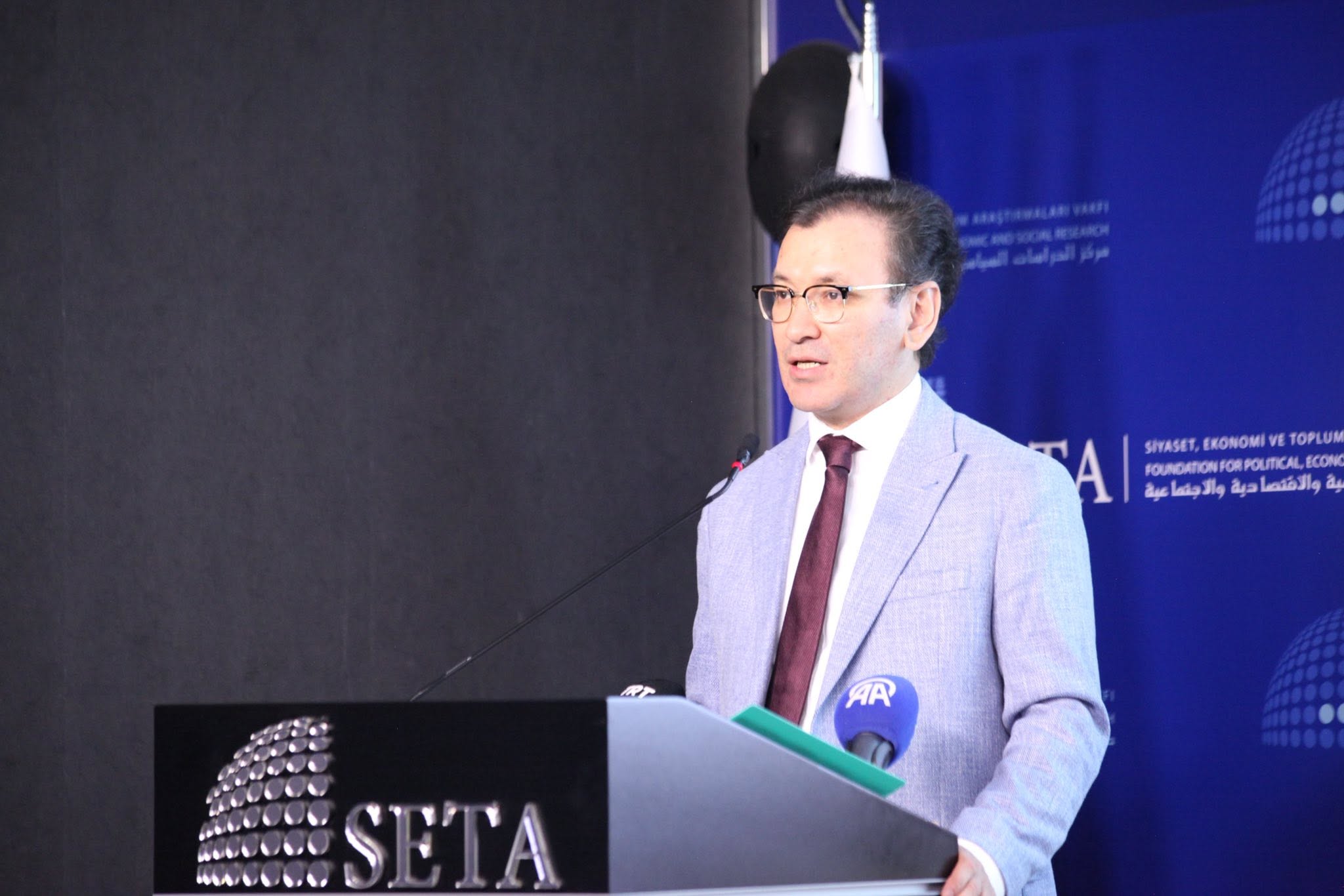
It is a great honor to speak at this inaugural Central Asia – Türkiye Think Tank Forum.
First and foremost, I would like to extend my sincere appreciation to Mr. Nebi Miş, General Coordinator of the SETA Foundation, whose dedication, and invaluable contributions have been instrumental in organizing this event.
Distinguished participants,
It is a great honor to welcome all of you to the inaugural Central Asia–Türkiye Forum.
The very title of our conference – “Roots and Prospects” – reflects the essence of our dialogue. Central Asia and Türkiye are connected by deep historical, cultural, spiritual and linguistic bonds. These roots are real, and they remain an important foundation of mutual trust.
But roots alone are not enough. In today’s world, historical closeness must be transformed into strategic coordination, economic complementarity, institutional cooperation and practical projects. This is why today’s Forum is both timely and necessary.
Türkiye was the first country to recognize the independence of the Central Asian states in 1991. Since then, Türkiye has consistently supported the independence, stability and development of our region. For Central Asian countries, Türkiye has always been a close friend, a bridge to wider markets, and an important political, economic and cultural partner.
By now, Türkiye has emerged as an influential actor across the Middle East, the South Caucasus, and the wider Eurasian space, making important contributions to regional connectivity and dialogue. Ankara has also become one of the key strategic partners, linked to the region by common interests in promoting sustainable development.
Today we are entering a new stage. Since 2017, Central Asia has changed significantly: regional dialogue has intensified, borders have opened, trade has grown, and our common regional identity has become stronger.
Central Asia is no longer only a geographic expression. It is becoming a consolidated political and economic space with its own voice, interests and priorities.
The region’s geography is also expanding. The Tashkent Summit of November 2025 marked a historic step with Azerbaijan joining the regional cooperation format as a full participant. This gives the traditional C5 framework a broader C6 dimension and creates new opportunities for deeper cooperation with Türkiye through the South Caucasus, the Caspian region, energy links and transport corridors.
Dear friends,
Within this broader regional context, Uzbekistan–Türkiye relations have matured into a comprehensive strategic partnership, driven by the strong political will, strategic vision and personal commitment of President Shavkat Mirziyoyev and President Recep Tayyip Erdoğan.
A major milestone was the meeting of two leaders in Ankara on June 6, 2024, which resulted in the Joint Declaration on Deepening the Comprehensive Strategic Partnership. This momentum was further strengthened by the 4th meeting of the High-Level Strategic Cooperation Council, held here in Ankara in January 2026, opening new opportunities for economic growth, regional connectivity and the well-being of our peoples.
Dear colleagues,
Today, Central Asia is developing more than a dozen “Central Asia Plus” formats with major global and regional partners, including the United States, China, Russia, the European Union, Japan, South Korea, India, the Gulf countries and others. This reflects the region’s growing international agency, but also creates a need for better coordination so that external partnerships strengthen regional consolidation, not fragmentation.
This is why the Central Asia–Türkiye format is important. It does not replace the Organization of Turkic States, the Economic Cooperation Organization, the Organization of Islamic Cooperation, the Shanghai Cooperation Organization, the Organization for Security and Co-operation in Europe, the Central Asia Regional Economic Cooperation Program or other platforms. Rather, it can complement them by bringing together all Central Asian countries and Türkiye around a focused practical agenda covering economy, investment, technology, energy, transport connectivity, education and culture.
In this sense, the Forum should become an expert mechanism that connects political will with practical implementation.
Dear friends,
The economic foundation of our partnership is becoming stronger.
Trade between Türkiye and Central Asia has more than doubled since 2018 – from around 6 billion dollars to 14.5 billion dollars in 2025. The next target is 30 billion dollars by 2030. This is ambitious, but realistic.
Turkish investment in Central Asia has also grown rapidly. From 2016 to 2024, it increased 2.5 times – from 1.1 billion dollars to around 3 billion dollars. The number of Turkish companies operating in the region grew from around 4,000 in 2016 to more than 7,000 by 2025.
This shows that Türkiye is not only a trade partner. It is becoming an investor, builder, producer, logistics and technology partner for Central Asia.
Dear colleagues,
Connectivity is the backbone of the Central Asia–Türkiye partnership.
The Middle Corridor is no longer only an alternative route. It is becoming a strategic economic artery linking China, Central Asia, the Caspian Sea, the South Caucasus, Türkiye and Europe.
According to international assessments, the Middle Corridor has the potential to triple freight volumes and halve travel time by 2030 if the right investments and policy reforms are implemented. Cargo flows have already increased significantly in recent years. Container transportation is also growing, with further expansion expected by the end of the decade.
For Central Asia, this is a historic opportunity to overcome landlocked geography. For Türkiye, it strengthens its role as a Eurasian transport and logistics hub. For Azerbaijan and the South Caucasus, it creates new transit and industrial opportunities. For Europe and Asia, it creates a more diversified and resilient supply chain.
But we should be realistic. The Middle Corridor will not become fully competitive automatically. It requires synchronized tariffs, digital documentation, predictable customs procedures, efficient Caspian shipping, modern port infrastructure, multimodal logistics centers, and better coordination among railways, ports and private operators.
This is another reason why the Central Asia–Türkiye Forum is important. We need expert-level work on where the corridor loses time, where costs increase, where documentation is duplicated, and where private investment can be mobilized.
Connectivity should also be understood more broadly. It includes not only railways and ports, but also aviation, digital infrastructure, energy grids, fiber-optic lines, financial connectivity and people-to-people mobility.
Recent developments in the Middle East have once again shown how closely regional connectivity is linked to global stability. Disruptions around key maritime routes, including the Red Sea, the Suez Canal and the Strait of Hormuz, affect transport costs, insurance rates, energy prices and the predictability of supply chains. For landlocked Central Asian countries, this makes the development of reliable alternative routes even more important.
In this regard, we also welcome the U.S.–Iran agreement signed yesterday in France by President Donald Trump. For Central Asia, this is an important development. Iran is part of our wider neighborhood and plays a significant role in regional stability, energy security, transport connectivity and access to southern ports.
Energy cooperation is another pillar of the future partnership.
Central Asia has vast energy potential: Kazakhstan has major oil and uranium resources, Turkmenistan holds one of the world’s largest natural gas reserves, Uzbekistan is expanding renewable energy, gas chemistry and nuclear energy, while Kyrgyzstan and Tajikistan have significant hydropower potential.
Türkiye, in turn, is strengthening its role as a regional energy hub. TANAP, the Southern Gas Corridor and the Baku–Tbilisi–Ceyhan pipeline show how the Caspian region can be connected to Türkiye and global markets. Discussions on Turkmen gas supplies through Türkiye are also strategically important.
At the same time, the future of energy cooperation is not limited to oil and gas. It also includes green energy, electricity transmission, hydrogen, energy efficiency and critical minerals. The Caspian Green Energy Corridor, involving Uzbekistan, Kazakhstan and Azerbaijan, can become a new-generation connectivity corridor linking Central Asian renewable energy potential with Türkiye and European markets.
Critical minerals are equally important. Central Asia holds significant reserves of manganese, chromium, lead, zinc, titanium, copper, cobalt, molybdenum, uranium and other strategic resources. Uzbekistan, for example, has launched a 2.6-billion-dollar program covering 76 projects for 28 rare and critical minerals.
The key task is to move from extraction to value addition. Together with Türkiye and other partners, Central Asia should develop processing, metallurgy, industrial components, battery materials, green technologies and research cooperation. Türkiye’s industrial base and engineering capacity can complement Central Asia’s resource base and create long-term strategic value.
Dear colleagues,
Technology and digital cooperation should also become a priority.
In particular, parntership in artificial intelligence, digital public services, fintech, cybersecurity, smart logistics, agricultural technologies and water-saving solutions can open new areas of practical interaction.
Türkiye’s experience in digital governance, industrial innovation, technoparks and start-up ecosystems is highly relevant for Central Asia, while our region offers young human capital, expanding markets and growing demand for digital solutions.
With more than 80 million people and a large share of the population under 30, human capital is one of Central Asia’s greatest strategic assets.
Türkiye already hosts more than 300,000 international students, and joint academic programs are expanding across Central Asia. In Uzbekistan, the International University of Turkic States in Tashkent is an important step in this direction. We should build on this foundation through joint degree programs, vocational training, digital skills, youth exchanges and research cooperation.
Dear friends,
The purpose of today’s Forum is not only to describe achievements. It is to identify the next stage.
In this context, the Forum could focus on several practical mechanisms for advancing our shared agenda. These include strengthening financing instruments for large-scale infrastructure, energy and digital transformation projects, including through the further development of the Turkic Investment Fund.
They also include addressing persistent connectivity bottlenecks, such as railway modernization and integration, challenges along the Caspian transport corridor, and the declining water levels of the Caspian Sea. Equally important are the harmonization of tariffs, customs procedures and regulatory frameworks, as well as more effective use of “Central Asia+” and “OTS+” formats to engage external partners, including the Gulf countries, the European Union and China, in mutually beneficial initiatives.
The International Institute for Central Asia is ready to contribute to this work. We are prepared to cooperate with Turkish think tanks, universities, research centers and policy institutions in preparing joint studies, expert dialogues and practical recommendations.
To sum up, I want to highlight that we are living in a time of global uncertainty, competition for resources, disruption of supply chains and growing demand for reliable partners. In such conditions, stable and predictable partnerships become a strategic asset.
Central Asia and Türkiye have everything needed for such a partnership: trust, geography, culture, economic complementarity, transport corridors, energy potential, young human capital and political will.
The task before us is to connect these elements into a coherent strategy.
This Forum can become an important step in that direction. It can help move our cooperation from general declarations to concrete projects, from historical closeness to modern partnership, and from separate initiatives to a shared strategic vision.
Thank you for your attention.