Distinguished participants,
Dear colleagues and friends,
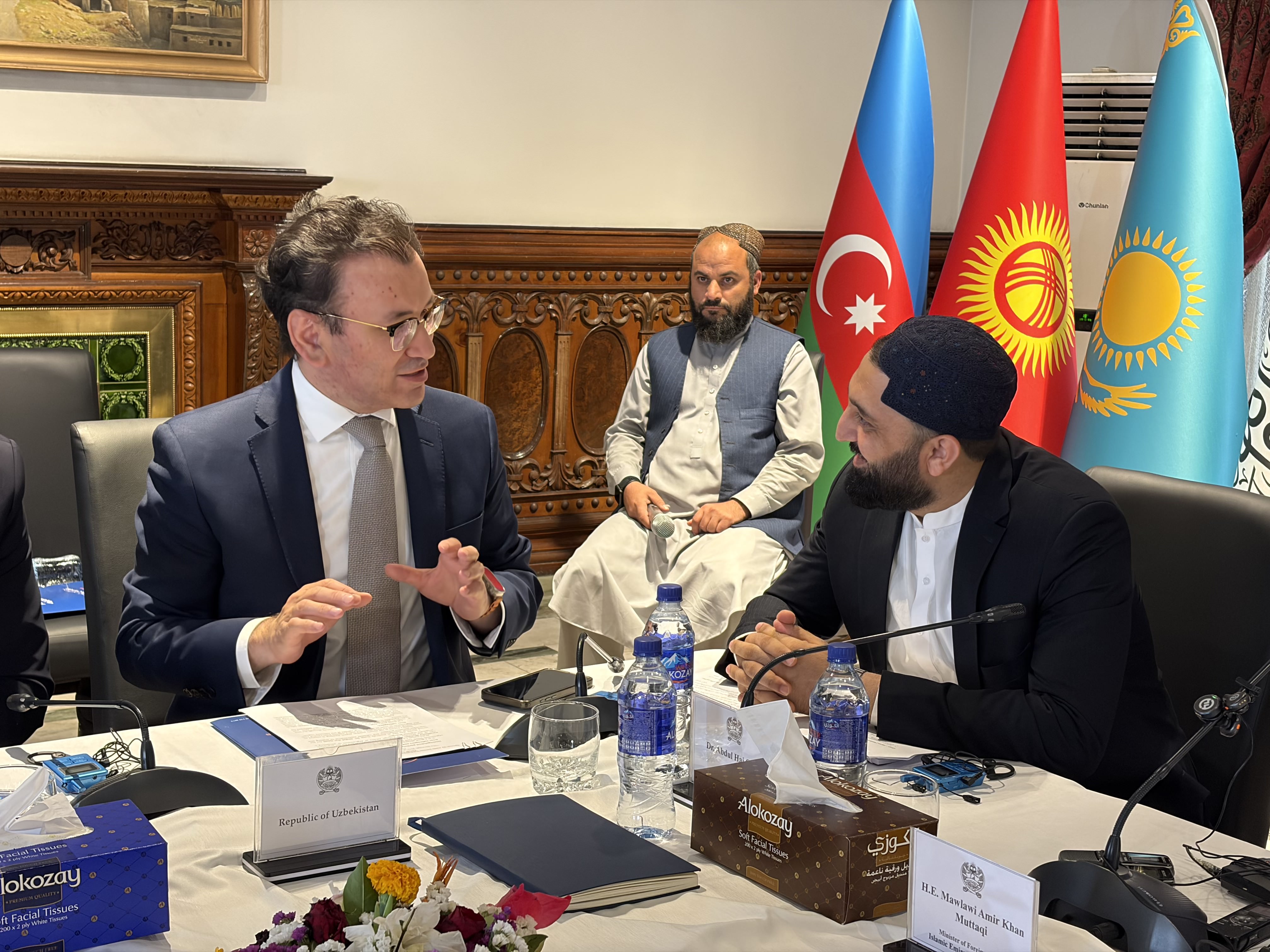
It is a great pleasure and honor to speak at the first Central Asia–Afghanistan Think Tank Forum.
At the outset, I would like to express our sincere appreciation to His Excellency Minister Muttaqi for his participation and for the important role of the Ministry of Foreign Affairs of Afghanistan in advancing a pragmatic regional dialogue.
I would also like to sincerely thank Dr. Abdul Hai Qanit for his strong personal commitment and valuable contribution to making this important initiative possible.
Today’s Forum is not simply another expert meeting. It creates an institutional channel for think tanks and policy experts from Central Asia and Afghanistan to work on the practical agenda of our common region.
Dear colleagues,
For many years, Afghanistan was discussed mainly through the lens of conflict, instability, and external crisis management. This was understandable in the context of the past. But it is no longer sufficient for the future.
Earlier formats offer useful lessons. The “6+2” mechanism, which brought together Afghanistan’s six neighboring countries, the United States and Russia under UN auspices, led to the 1999 Tashkent Declaration and showed that Afghanistan’s future cannot be addressed without the region. The Heart of Asia–Istanbul Process later expanded this logic through confidence-building measures in trade, infrastructure, education, agriculture and security. The Oslo meetings of 2022 also confirmed the importance of pragmatic dialogue with the Afghan side on humanitarian and practical issues.
Today, however, the agenda should move beyond conflict management. We should not mechanically restore old formats, but preserve their useful principles: regional ownership, practical cooperation, confidence-building and engagement with international partners where appropriate. The focus now should be connectivity, trade, investment, energy, water, education and regional development.
Dear friends,
Today we are witnessing the emergence of a broader regional space. The idea of a New Central Asia is gaining real institutional content. Last year’s Tashkent Summit marked an important step in this direction, including Azerbaijan’s accession as a full participant in the Consultative Meetings of the Heads of State of Central Asia. This shows that Central Asia is increasingly connected with the South Caucasus, the Caspian region, Europe, South Asia and the Middle East.
In this emerging Greater Central Asia, Afghanistan is not a periphery. It is the southern gateway of our region, linking Central Asia with South Asia, the Indian Ocean and West Asia. Therefore, Afghanistan’s stability and economic recovery are directly connected with the future development of Central Asia.
According to the World Bank, Afghanistan’s economy has shown signs of recovery, with growth estimated at around 4.3 percent in 2025 and expected to remain near 4 percent in 2026. Its trade is also diversifying. In 2025, Afghanistan’s total trade was estimated at almost 14 billion dollars, while trade with Central Asia has already reached approximately 2.7 billion dollars. The Afghan side has set an ambitious goal of increasing this figure to 10 billion dollars in the coming three to four years.
This goal can be achieved only through joint work on transport costs, customs procedures, logistics infrastructure, payment mechanisms, border management and private-sector cooperation. Here, think tanks can play a practical role by identifying bottlenecks, comparing routes, analyzing border delays and preparing recommendations for governments, transport operators, chambers of commerce and development partners.
Dear colleagues,
Connectivity should become one of the central pillars of Central Asia–Afghanistan cooperation.
The Trans-Afghan Transport Corridor is especially important in this regard. It should not be viewed only as a railway project. It should be understood as a wider development corridor. Around such a corridor, we can build logistics centers, industrial zones, dry ports, trade services, customs cooperation, digital documentation, and private-sector partnerships.
The same applies to energy connectivity. Projects such as TAPI, TAP, CASA-1000, and related electricity and energy infrastructure can help Afghanistan become not only a transit space, but also a participant in regional production, consumption, and industrial development.
Afghanistan’s deeper involvement in such practical regional mechanisms could help connect national projects with broader regional corridors.
But infrastructure alone is not enough. We need institutions. We need predictable rules. We need data. We need expert analysis. We need trust between ministries, transport operators, customs bodies, investors, and local communities. This is exactly where think tanks and analytical centers can add value.
Dear friends,
Another strategic issue is water and climate cooperation.
Water security in the Amu Darya basin is directly linked to agriculture, food security, ecology, energy production and social stability. The President of Uzbekistan has emphasized that this issue requires a legal and institutional framework that takes into account the rights and responsibilities of all countries in the basin, including Afghanistan.
In this context, Afghanistan’s water infrastructure development, including the Qosh Tepa Canal, makes regional dialogue even more important. Such projects create a need for regular technical consultations, transparent exchange of information and a cooperative approach based on mutual respect and shared responsibility.
Tashkent Water Week 2026 showed that practical dialogue is possible. The Afghan delegation took an active part in the forum, and the Afghan side reaffirmed its readiness for constructive cooperation and dialogue on transboundary water issues.
Recent expert reports, including by the Stockholm International Water Institute, also stress the importance of gradually involving Afghanistan in technical discussions, data-sharing platforms, joint monitoring, climate adaptation, glacier monitoring and early warning systems.
This is where expert institutions can make a practical contribution. Water cooperation requires technical dialogue, scientific data, comparative analysis and confidence-building. Regional programs such as the Central Asia Water and Energy Program, Green Central Asia and Blue Peace Central Asia can provide useful platforms for expanding expert engagement with Afghanistan.
Dear colleagues,
The humanitarian and cultural dimension should also remain an important part of our cooperation.
Afghanistan and Central Asia are connected by history, religion, culture, language, trade routes, and shared intellectual traditions. Representatives of Afghanistan regularly visit sacred Islamic sites in Uzbekistan. Afghan guests show strong interest in the Center of Islamic Civilization in Tashkent and the renovated Imam al-Bukhari Memorial Complex in Samarkand.
This cultural foundation matters. It creates trust. It reminds us that cooperation with Afghanistan is not an artificial agenda imposed from outside. It is rooted in geography, history, and civilizational closeness.
Education and professional training should also become a priority. Afghan experts, young researchers, diplomats, technical specialists, water managers, transport specialists, and economists should be more actively involved in regional capacity-building programs. It is an investment in long-term stability and regional competence.
Dear friends,
The main topic of today’s Forum – think tank-to-think tank partnership and institutional cooperation – is especially relevant.
Official dialogue sets the political direction, but expert institutions help develop practical content. This fully corresponds to the mission of the International Institute for Central Asia: to support regional cooperation through applied research, expert dialogue and policy recommendations on sustainable development, security and connectivity in Central Asia and broader “Central Asia plus” formats.
Since the beginning of this year, IICA has been actively working with the Center for Strategic Studies at the Ministry of Foreign Affairs of Afghanistan. The Protocol of Cooperation signed in April created an institutional basis for regular dialogue, joint research and closer coordination on key regional issues.
Our Institute has also built partnerships with more than 90 leading international think tanks and research institutions. We are ready to use this network to help expand contacts between our Afghan partners and the wider international expert community.
Looking ahead, the Central Asia–Afghanistan format could be strengthened through more active Afghan participation in several practical areas.
First, Afghanistan could be more closely involved in C5 sectoral platforms on trade, transport and logistics, water management, energy and education, as well as in smaller regional formats focused on the Amu Darya basin and major infrastructure projects.
Second, expert engagement with Afghanistan could be expanded through regional and international platforms, including the Organization of Islamic Cooperation, the Economic Cooperation Organization, the SCO Contact Group on Afghanistan and CAREC-related knowledge platforms.
Third, Afghan experts and mid-level officials could be more actively involved in discussions on sustainable development, water security, climate adaptation, digital connectivity and disaster risk reduction. Existing initiatives such as the Central Asia Water and Energy Program, Green Central Asia, Blue Peace Central Asia and the Central Asia Knowledge Network can provide useful channels for this work.
The main principle is clear: Afghanistan should be involved not as an object of discussion, but as a participant and co-author of regional cooperation. This requires regular dialogue, expert cooperation, institutional partnerships, practical projects and long-term trust-building.
The priorities recently outlined by His Excellency Minister Muttaqi at the Central Asia – Afghanistan Consultative Dialogue Meeting, including regular dialogue, a practical roadmap, coordinated approaches to security, stronger trade and transit links, and cooperation on climate and water, fully correspond to the goals of this Forum.
We support this approach and believe that the Think Tank Forum can become an expert track for turning these priorities into concrete proposals, research papers and practical recommendations.
In conclusion, I would like to say that the International Institute for Central Asia is ready to consider hosting the next Central Asia–Afghanistan Think Tank Forum in Tashkent next year.
We believe that holding the next Forum in Tashkent would help ensure continuity in our dialogue. It would also build on Uzbekistan’s active role in supporting Afghanistan’s involvement in regional processes.
At the same time, it would allow us to use the potential of the International Institute for Central Asia as a regional platform for developing joint ideas, practical recommendations, and common approaches aimed at strengthening trust, cooperation, and shared development between Central Asia and Afghanistan.
Let this Forum become not only a place for speeches, but a mechanism for continuity.
Let it become an expert bridge between our countries.
And let it help us build a region where Afghanistan is not isolated from Central Asia, but connected with it through trust, trade, knowledge, infrastructure, and common responsibility.
Thank you for your attention.