Distinguished participants,
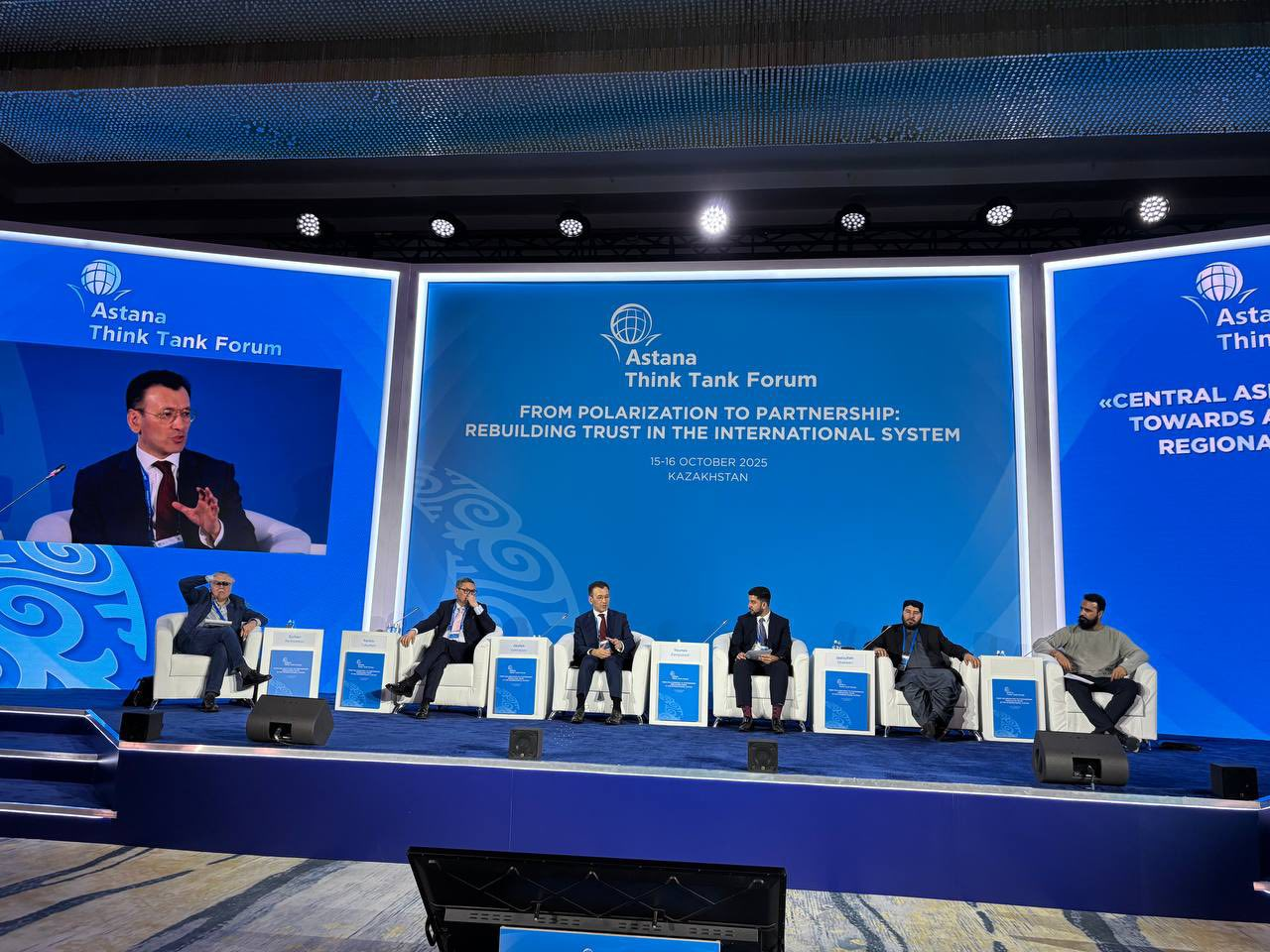
First of all, let me express my sincere gratitude for organizing today’s international forum. This is my second time participating in this event, and I am pleased to once again have the opportunity to discuss important issues of regional cooperation, sustainable development, and the security of our countries.
1.Turning to today’s agenda, I would like to emphasize the particular importance of the topic under discussion. We live in an era of profound geopolitical transformation, and against this backdrop, Central Asia has once again found itself at the center of international attention – both because of its strategic location and the large-scale internal transformations taking place within our states.
In this regard, regional cooperation – particularly interaction with Afghanistan – plays a crucial role. This is driven not only by the geopolitical significance of the region, but also by the need for joint responses to cross-border challenges, including those related to security and sustainable development.
Unfortunately, the international community has not yet managed to develop a unified and coordinated policy toward the Taliban government. At the same time, a number of countries already regard the Taliban not yet de jure legitimate, but de facto a functioning governing authority in Afghanistan. Most neighboring states, whose economic interests and security are directly dependent on stability in the region, have opted for pragmatic engagement with Kabul.
Over the past four years, the Taliban have sent diplomats to a number of countries, including China, Russia, Qatar, Türkiye, Pakistan, Iran, and the UAE, among others. Russia became the first country to officially recognize the Islamic Emirate of Afghanistan, headed by the Taliban movement. China was the first to officially accept an ambassador appointed by the new Afghan administration. Even India, which had previously expressed serious concern over the Taliban’s rise to power, is now reactivating its infrastructure initiatives in Afghanistan and may soon fully reopen its embassy in Kabul.
- 2. The Central Asian countries, too, from the very first days, have been developing dialogue and cooperation with the new authorities in Afghanistan – in areas ranging from trade and infrastructure to education and humanitarian assistance – in the interest of ensuring stability and development across the region.
Turkmenistan was among the first to resume engagement, launching bilateral trade and infrastructure projects. Tajikistan, while maintaining a firm political stance toward Afghanistan’s internal situation, continues to supply electricity and preserve a certain level of trade relations. Kazakhstan and Kyrgyzstan have removed the Taliban from their national lists of terrorist organizations and are developing economic and humanitarian cooperation.
For its part, Uzbekistan, since 2017, has moved away from viewing Afghanistan solely as a source of threats and has instead adopted a policy of engagement based on trust and partnership. A stable and interconnected Afghanistan benefits the entire region – opening new markets, trade routes, and access to a growing labor force. This pragmatic approach has continued after the withdrawal of foreign troops.
Our country regards Afghanistan as an integral part of Central Asia and conducts its foreign policy according to the principle of “stability through connectivity.” This approach is based on good neighborliness, respect for sovereignty, and non-interference in internal affairs, reflecting Uzbekistan’s consistent support for a peaceful, stable, and economically viable Afghanistan.
The new authorities in Kabul have also demonstrated readiness for peaceful cooperation with all neighboring countries and international organizations. However, many of the Taliban’s efforts to act as a responsible political force capable of ensuring a degree of stability in the country have yet to receive due recognition from the international community.
It is important to highlight several positive developments: reduced levels of violence, improved logistics, anti-corruption measures, and a 95% reduction in opium production, according to UN reports. Moreover, the level of terrorism in Afghanistan has significantly declined since the Taliban came to power.
According to the 12th edition of the Global Terrorism Index prepared by the Institute for Economics and Peace (IEP), Afghanistan has not been among the world’s five most terrorism-affected countries for the second consecutive year – ranking ninth in 2025.
Progress has also been recorded in foreign and transit trade. In 2023–2024, Afghanistan registered a significant GDP growth of 2.7%, its first notable increase since 2019. According to a UN report published in July 2024, the Taliban managed to substantially boost budget revenues. The Afghan Revenue Authority reported that from March 21, 2023, to March 20, 2024, the total official revenues of the Taliban reached approximately $3 billion – a 30% increase compared to the previous fiscal year ($2.2 billion).
At the same time, Afghanistan today faces a deepening humanitarian crisis, particularly due to declining international support. As of May this year, the Humanitarian Needs and Response Plan for Afghanistan (2025) was funded at only 16% of the required $2.42 billion. The situation is further aggravated by the mass return of refugees – according to the UN, since 2023, their number has exceeded 3.4 million. The European Commission reports that 22.9 million people in Afghanistan currently depend on international aid.
These positive shifts and remaining challenges requiring joint responses should serve as the foundation for deepening cooperation and strengthening mutual trust. In this regard, it is essential to reinforce these aspirations through tangible projects and humanitarian initiatives.
Dear colleagues,
Uzbekistan today leads the implementation of transformative projects such as the Trans-Afghan Railway and the Surkhan–Puli-Khumri Power Transmission Line, designed to turn Afghanistan into a continental bridge between Central and South Asia. The creation of a Free Economic Zone (FEZ) in Termez – already visited by tens of thousands of Afghans – has turned the city into a center of trade and humanitarian engagement.
In 2024, trade between Uzbekistan and Afghanistan exceeded $1.1 billion, clearly demonstrating the deepening of our partnership. Moreover, since 2021, Uzbekistan has sent 13 shipments of humanitarian aid to Afghanistan.
However, trade and aid alone are not enough. That is why Uzbekistan is building sustainable platforms for economic, educational, and social reintegration.
In 2022, with Uzbekistan’s support, the Mawlawi Jalaluddin Balkhi International Airport in Mazari-Sharif was restored.
In 2024, a 36-hectare Free Economic Zone opened in Termez, fully equipped with customs, warehouse, hotel, educational, and medical facilities. Afghan citizens can stay in the zone for up to 15 days without a visa. More than 90,000 visitors — including over 40,000 Afghans — have visited it. The zone serves not only as a trade hub but also as a vital link connecting Afghanistan with the wider region.
Additionally, last year Uzbekistan signed a 10-year contract to invest nearly $1 billion in Afghanistan’s energy sector, beginning with gas exploration and electricity generation at the Tuti-Maidan gas field in Jowzjan Province.
Overall, the growing regional engagement reflects a shared sense of collective responsibility and common interests among Central Asian states. A vivid example of this was the first meeting of the Special Representatives of Central Asian Countries on Afghanistan, held at Uzbekistan’s initiative on August 26, 2025.
Undoubtedly, this mechanism will, in the long term, contribute
to strengthening the independent and responsible role of Central Asian countries in shaping the regional agenda on Afghanistan and ensuring the sustainable development of the broader macro-region.
In light of the need for coordinated regional steps on the Afghan track, we propose developing a Joint Action Plan for the Contact Group on Afghanistan under the Consultative Meeting of the Heads of State of Central Asia - at the level of special representatives. This would help establish a clear agenda, define priority areas of cooperation, and create a sustainable mechanism for regional engagement on Afghan issues.
Given the complementary nature of the infrastructure initiatives pursued by Central Asian countries in Afghanistan, it is now time to move from fragmented actions toward a coordinated regional approach. In this context, it is essential to establish common platforms for aligning infrastructure projects, jointly promoting key initiatives internationally, and treating Afghanistan as a strategic asset for regional development.
Moreover, developing effective models, mechanisms, and tools for ensuring stability, security, and sustainable development should remain at the center of attention for expert communities in Central Asian countries. In this regard, it would be advisable to hold an international forum in the “Central Asia–Afghanistan” format, with the participation of leading Afghan think tanks. Such a forum could serve as a platform for knowledge exchange, discussion of current challenges, and the development of joint proposals aimed at strengthening regional resilience, supporting Afghanistan’s economic recovery, and deepening mutual understanding between the countries of the region and Kabul.
Given the common challenges and overlapping interests of Central Asian countries and Afghanistan, especially in strategically important areas such as energy, transport connectivity, water resources, and agriculture, new approaches are needed to build sustainable and coordinated regional cooperation based on the principles of mutual benefit, good neighborliness, and long-term partnership.
In this regard, it seems appropriate to hold an international business forum in the "B5+1" format with the participation of representatives of the business communities of the Central Asian countries and Afghanistan. Such a forum could become an important platform for dialogue, strengthening mutual understanding, and coordinating efforts to ensure sustainable development and stability throughout the entire region.
In the context of water scarcity, climate change, and growing needs, the sustainable management of the Amudarya basin is impossible without the participation of all water-using countries. Afghanistan plays a vital role in forming the river's flow – a key water source for Central Asia – as a significant part of the water resources originates on its territory, making the country an integral part of the regional water management system.
In this connection, it is advisable to integrate Afghanistan to the regional dialogue on water use, including within the framework of the Interstate Commission for Water Coordination (ICWC). This will create a basis for preparing a multilateral agreement that enshrines coordinated approaches to the use of the transboundary water resources of the Amudarya and takes into account the interests of all parties.
In conclusion, the integration of Afghanistan into regional cooperation processes is the key to sustainable security and stable development throughout Central Asia.
It not only strengthens mutual trust among our countries but also opens new opportunities for joint infrastructure projects, trade, and humanitarian interaction – ultimately benefiting the entire macro-region.