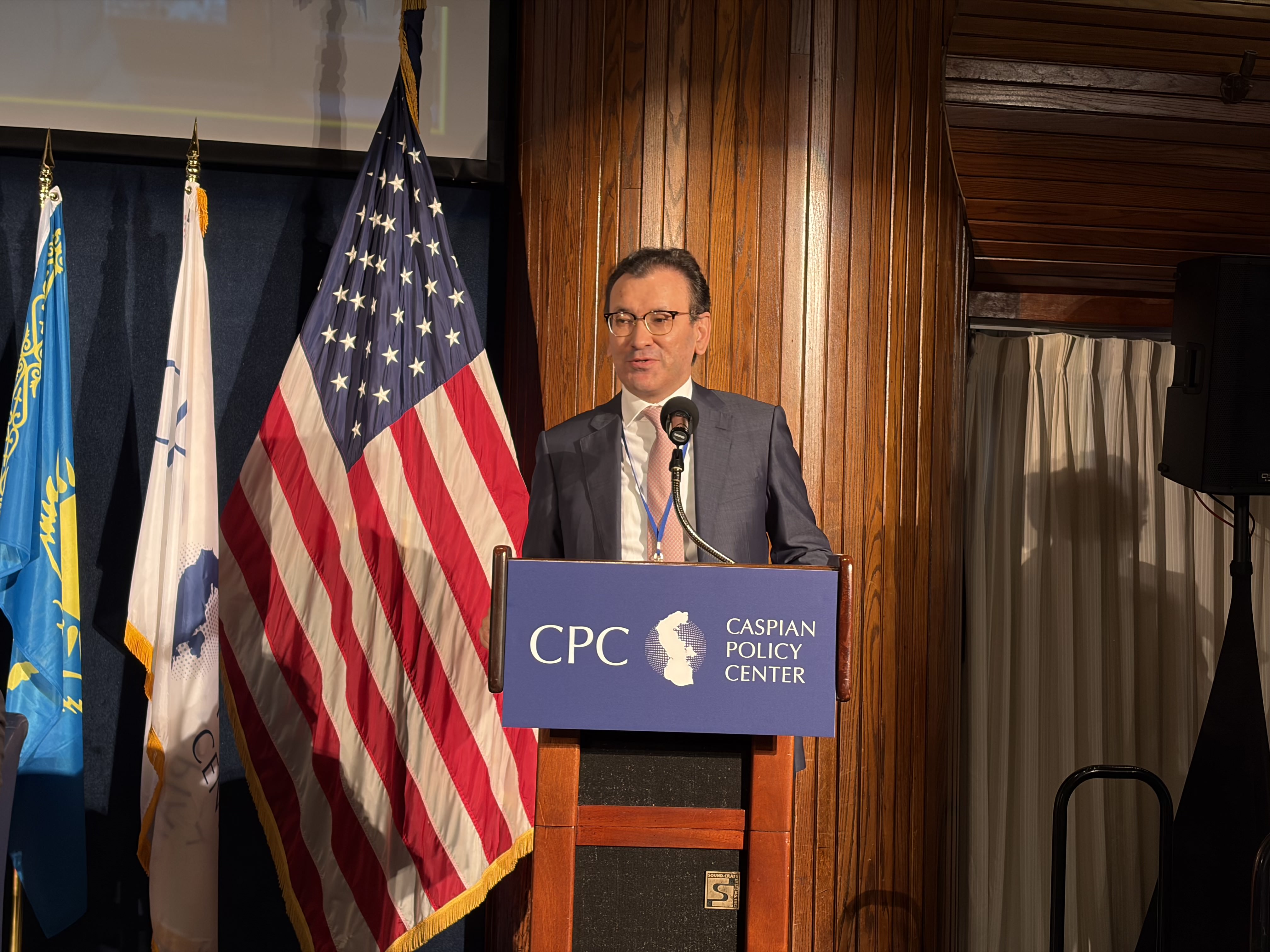
Excellencies, distinguished colleagues, ladies and gentlemen,
Thank you for the opportunity to speak at this important gathering.
Since this panel looks at Trans-Caspian connectivity from the perspective of the region, I would like to focus on what the Middle Corridor means for Uzbekistan.
For us, the Middle Corridor is not a fashionable geopolitical phrase. It is a practical question: how does a double-landlocked country reduce the cost of reaching world markets?
This matters because Uzbekistan is no longer the same economy it was ten years ago. In 2015, our total foreign trade was around 25 billion dollars. By 2025, it had grown more than threefold, exceeding 81 billion dollars. But the pressure on logistics has grown as well.
For Uzbekistan, logistics is not just transport. It is competitiveness. World Bank analysis has estimated Uzbekistan’s logistics costs at around 8 billion dollars, and more than half of freight transport costs are incurred outside our territory. This means we can reform our own customs, roads, railways, and logistics centers, but still face high costs if the regional corridor does not work properly.
That is why Uzbekistan looks at the Middle Corridor as a cost-reduction strategy, not simply as a transit route.
The corridor is already growing. Cargo volumes along the Trans-Caspian route increased from less than one million tons in 2020 to around 4.5 million tons in 2024. But we should also be honest: this is still modest compared to the scale of Eurasian trade. The Middle Corridor is promising, but it is not yet fully competitive. Its current capacity is still only around six percent of the northern route’s potential.
The reason is simple: this is not one railway, but a chain. Cargo moves by rail, then to a port, then across the Caspian Sea, then again by rail or road through the South Caucasus. Every transfer adds time, every border adds paperwork, and every delay becomes a cost.
There are also serious constraints: limited port capacity, slow transshipment, ferry shortages, and the declining water level of the Caspian Sea, which is falling by around 30 centimeters per year.
So the real question is not whether the corridor exists. It exists. The real question is whether it can be operated like one corridor.
Uzbekistan is already taking concrete steps in this direction.
In January 2025, President Mirziyoyev approved the Concept for the Development of Uzbekistan’s Transport and Logistics System until 2030. The targets are clear: bring annual transit cargo to 22 million tons, double exports of transport and logistics services, increase container transport by at least one and a half times, and triple the capacity of modern logistics centers.
These targets are part of our industrial strategy. Without cheaper and more predictable logistics, Uzbekistan cannot fully move into higher-value exports, manufacturing, and regional value chains.
Digitalization is another step. Uzbekistan and Türkiye were among the first countries in the Organization of Turkic States to introduce electronic permits for international road transport. In 2025, Uzbekistan and Azerbaijan also agreed to move fully to electronic permits for freight. For business, this means fewer papers, fewer delays, and more transparency.
Regional coordination is equally important. In August 2025, the leaders of Uzbekistan, Turkmenistan, and Azerbaijan met in Avaza. That meeting moved the discussion from general support to practical issues: using the ports of Turkmenbashi and Baku more effectively, building logistics infrastructure, coordinating tariffs, digitizing cargo control, and preparing a practical roadmap.
Uzbekistan also expressed readiness to reduce freight tariffs on a mutual basis. This matters because corridors compete not only by distance, but by price.
The Caspian Sea is the most difficult part for Uzbekistan.
We have no coastline and no long maritime tradition. But if we are serious about the Middle Corridor, we have to understand ferries, terminals, port schedules, cargo handling, insurance, and ship financing.
This is why Uzbekistan is now exploring its own ferry capacity on the Caspian Sea. Our transport officials have noted that cargo can sometimes wait 30 to 40 days for ferry movement. Uzbekistan is therefore considering leasing or purchasing vessels, including possible options from shipyards in Turkmenistan and Azerbaijan. In July 2025, Uzbekistan and Azerbaijan signed a protocol on cooperation in shipping and shipbuilding.
But at the same time, we understand that new shipbuilding orders can take five to seven years, so we are considering leased/chartered vessels and working with international “Big Four” advisers (Deloitte, PwC, EY, and KPMG) and domestic transport operators on a viable model.
This is not about prestige. It is about guaranteed capacity and predictable schedules. If Uzbek cargo has reliable ferry access, exporters can plan better, contracts become safer, and the whole corridor becomes more attractive.
This is also where the United States can be useful. The corridor needs practical American involvement: ferry leasing and financing, port management, insurance, digital logistics platforms, customs technology, warehouse management, and training of specialists.
The World Bank estimates that, with sufficient investment and policy reforms, freight volumes along the Middle Corridor could triple and travel times could be reduced by half by 2030. That is the scale of opportunity.
Since there is no representative of Turkmenistan on this panel, allow me to say a few words about Turkmenistan’s role as well, because it is essential for Uzbekistan.
For us, Turkmenbashi is one of the closest points where Uzbekistan reaches the Caspian Sea. The port can handle around 17 million tons of cargo a year, including 75 thousand trucks and about 400 thousand standard 20-foot containers. For Uzbekistan, this makes Turkmenbashi one of Central Asia’s main maritime gates.
But capacity on paper is not enough. What matters is how quickly cargo is processed, how predictable ferry schedules are, and how transparent tariffs are.
On the other side of the Caspian, Baku and Alat are equally important. The Port of Baku can handle around 15 million tons of cargo and 100 thousand standard containers a year, with expansion plans toward 25 million tons and 500 thousand containers. For Uzbekistan, Baku should become not only a transit point, but a hub for consolidating, storing, and distributing Uzbek and Central Asian cargo.
The China–Kyrgyzstan–Uzbekistan railway adds another dimension. After many years of discussion, this project is now moving into implementation. Its expected capacity is often estimated at up to 15 million tons a year.
For Uzbekistan, this is not only an eastern connection to China. It can become the eastern gate of a wider system. One direction is westward: through Uzbekistan, Turkmenistan, the Caspian Sea, Azerbaijan, Türkiye, and Europe. At the same time, Chinese and regional experts increasingly discuss a southern and south-western logic – through Turkmenistan, Iran, Türkiye, and further toward the Middle East and the Mediterranean.
The Trump Route for International Peace and Prosperity also matters in this discussion. If it becomes an open and commercially governed route, it can strengthen the western side of the Trans-Caspian system and create additional access toward Türkiye and Europe.
To sum up, Uzbekistan does not see the Middle Corridor only as a road to Europe. We see it as a way to change the economics of being landlocked.
If the corridor works properly, our producers pay less for transport, our exporters become more competitive, our logistics companies gain new markets, and our country becomes less dependent on any single direction.
For Uzbekistan, this is the real meaning of the Middle Corridor: not just transit, but competitiveness, resilience, and development.
Thank you.