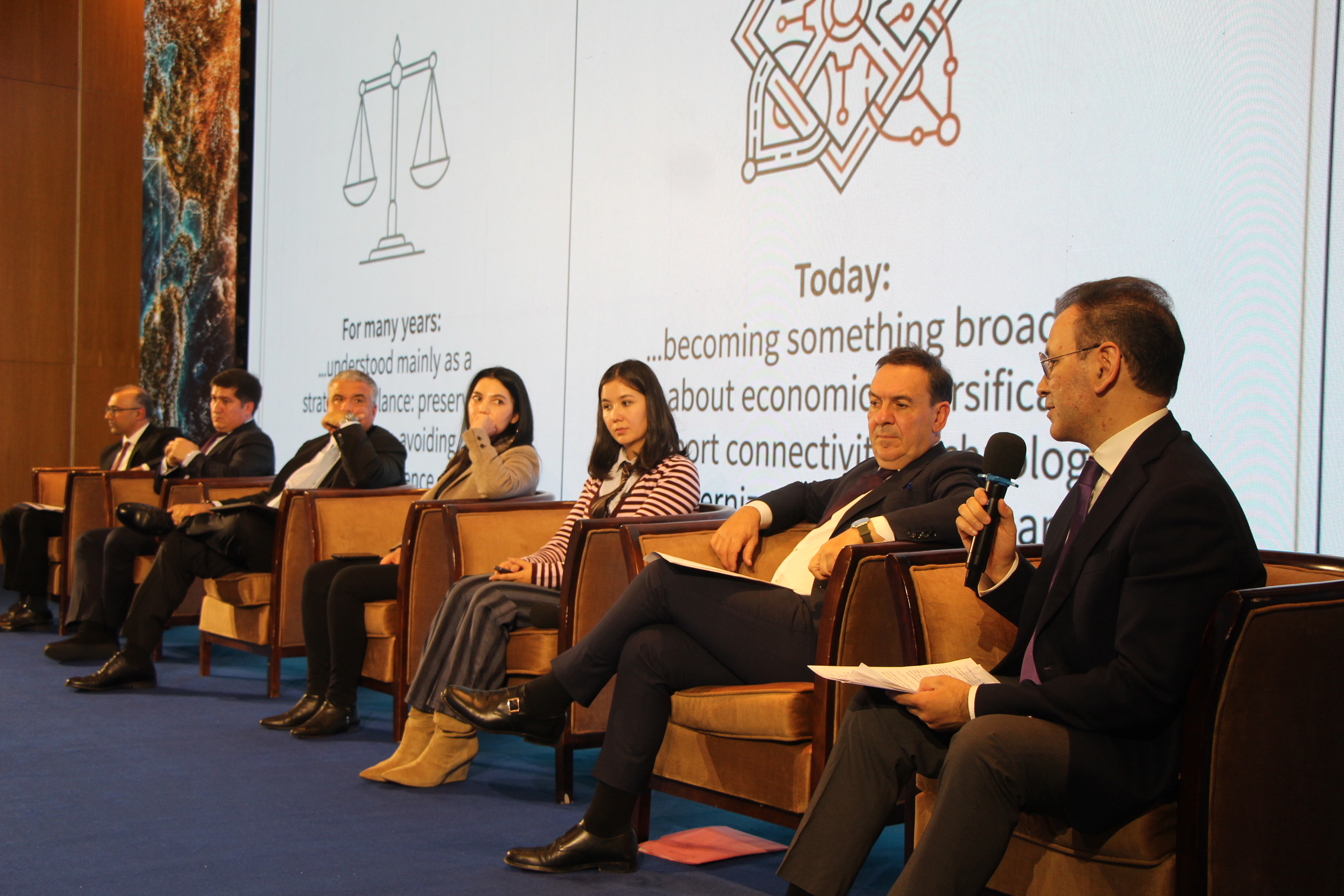
Distinguished Moderator,
Dear Colleagues,
As I have the opportunity to speak at the close of the first round, the final speaker has one small advantage: almost all the right things have already been said.
And one responsibility – to try not to say them all over again.
This year marks ten years since the beginning of a new phase of regional rapprochement in Central Asia. An important point of departure was the policy pursued by President Shavkat Mirziyoyev, built on good-neighborliness, open dialogue, and the conviction that regional issues should, first and foremost, be addressed by the neighboring countries themselves.
Just recently, on my way back from Khujand through the Oybek–Fotekhobod border crossing, I caught myself thinking about something very simple: crossing the border has become so routine that we hardly notice it anymore.
What only ten years ago could become a political issue has now become part of everyday life.
But an open border does not yet mean an integrated economy.
Over these years, Central Asia has moved from resolving accumulated bilateral issues to establishing a sustained multilateral dialogue. Importantly, we have deliberately chosen a path of flexible institutionalization: rather than replicating external models or creating supranational structures, we are developing precisely those mechanisms that are needed to address practical challenges.
It is equally telling that the very configuration of regional cooperation is evolving. Last year, at the Seventh Consultative Meeting in Tashkent, Azerbaijan joined the format as a full-fledged participant. This is more than simply an expansion of its membership. It adds a new dimension to our regional agenda – in trade, transport, energy, and investment cooperation.
In essence, a new and broader configuration of Central Asia is gradually taking shape before us – more consolidated internally, while at the same time becoming more closely connected with neighboring economic spaces.
There is also an external dimension to this growing maturity.
Today, there are already roughly a dozen “C5+1” formats. But their number is not what matters most.
What matters is that external partners are increasingly engaging with Central Asia not as five separate markets, but as a region capable of articulating common priorities.
To me, the “C5+1” formats are the external extension of Central Asia’s internal consolidation.
They give us greater scale for attracting investment, enable us to advance cross-border projects and bring in new technologies, and – particularly important for landlocked countries – help us diversify our external economic ties.
But the test of their effectiveness should be simple:
every “C5+1” format should strengthen connectivity within Central Asia, rather than create new lines of fragmentation.
This is precisely why we, as analytical institutions, have been consistently complementing a number of these formats with dedicated expert tracks – with US, EU, Japan, Türkiye, India and other partners.
Political dialogue sets the direction.
The task of think tanks is to test ideas for feasibility, identify bottlenecks, and translate political agreements into practical proposals for governments.
Ahead of the Eighth Consultative Meeting of the Heads of State of Central Asia and Azerbaijan in Avaza, the central question, in my view, is no longer whether political trust exists, but rather:
what economic substance should we now give to the political trust we have accumulated?
In 2025, intra-regional trade among the Central Asian states reached 12 billion US dollars, almost doubling over the previous five years.
But the main gap today is no longer so much political as functional:
trust between our states has grown faster than the interconnectedness of our markets, energy systems and transport infrastructure.
I would highlight three areas in this regard.
FIRST – trade without artificial barriers and investment through industrial cooperation.
Recently, at the Fergana Peace Forum in Khujand, we proposed looking at the Fergana Valley not as a collection of separate territories, but as a distributed agro-industrial cluster.
Take a simple example – Uzbek grapes.
They can be viewed not merely as a finished national product, but as the starting point of a longer regional value chain: cultivation where conditions are most favorable; storage, processing and packaging where they are most economically efficient; and exports through the most competitive route.
In other words, value added does not necessarily have to be created in one place.
Integration begins when an entrepreneur chooses a partner based on economic efficiency, rather than on which side of the border that partner happens to be located.
This leads to a practical conclusion: we need cross-border trade and industrial zones, interconnected special economic zones, and joint production platforms.
The Termez International Trade Center on the border with Afghanistan is already demonstrating the logic of this approach:
a border should become not the edge of an economy, but a point where economies connect.
SECOND – water and energy complementarity.
Here, in my view, we have witnessed a fundamental shift in recent years.
Water and energy issues, which in the past often became a source of serious disagreements, are increasingly being addressed through joint projects, coordinated operating regimes, and practical management of shared resources.
This means that the question itself should now begin to change.
Not only:
“How much water does each country receive?”
But rather:
“How much value added do we create from every cubic meter of water?”
The countries of our region possess different comparative strengths.
Kyrgyzstan and Tajikistan have substantial hydropower potential. Kazakhstan, Turkmenistan and Uzbekistan have significant conventional generation capacity, while at the same time rapidly expanding renewable energy.
Our goal should not be five separate energy islands, but a single system of complementarity.
In practical terms, during the winter months, upstream countries could, under coordinated operating arrangements, retain more water in reservoirs, while part of their additional electricity demand could be covered through regional power supplies.
In summer, when water is particularly critical for agriculture, coordinated water releases could support both irrigation and hydropower generation.
In other words, water and energy should increasingly be viewed not as two separate national challenges, but as one interconnected regional economic system.
THIRD – transport connectivity.
And here, the issue is not only economic; it also has a political dimension.
For a landlocked country, diversification of transport routes is not a logistical luxury.
It is an element of economic resilience.
I would put it this way:
For a landlocked country, the most costly deficit is the lack of alternatives.
That is why the China–Kyrgyzstan–Uzbekistan railway, the Trans-Caspian route, and prospective trans-Afghan corridors should be viewed not as competing projects, but as elements of a single network.
We do not need to choose one route.
We need to have a choice of routes.
I recently had the opportunity to review a new World Bank report on the Trans-Caspian Corridor, and one point in particular struck me: the availability of alternative routes makes trade more resilient to geopolitical, infrastructure and climate-related shocks.
Diversification, therefore, is not directed against any particular partner.
It is directed against dependence on a single route.
But a transport corridor in itself does not yet constitute development.
Along the China–Kyrgyzstan–Uzbekistan railway, we need to see the emergence of dry ports, agro-logistics hubs, processing facilities, warehouses and service infrastructure.
If freight trains simply pass through, we gain transit.
If production emerges around the railway, we gain development.
It was here in Avaza last year, at the Third United Nations Conference on Landlocked Developing Countries, that the President of Uzbekistan put forward initiatives on transit guarantees and logistics integration.
And now Avaza is preparing to host the next Consultative Meeting of the countries of our region.
There is a certain logic to this:
the global challenge faced by landlocked countries requires, first and foremost, regional solutions that actually work.
Distinguished colleagues,
We cannot change the geography of Central Asia.
But we can change what that geography means for our countries.
If we succeed in connecting our markets, transport routes, energy systems and production chains, being landlocked will cease to be an economic constraint and will remain merely a geographical fact.
This is what the next stage of regional integration is ultimately about – transforming Central Asia from a region constrained by geography into a region connected by opportunity.
Thank you for your attention.